
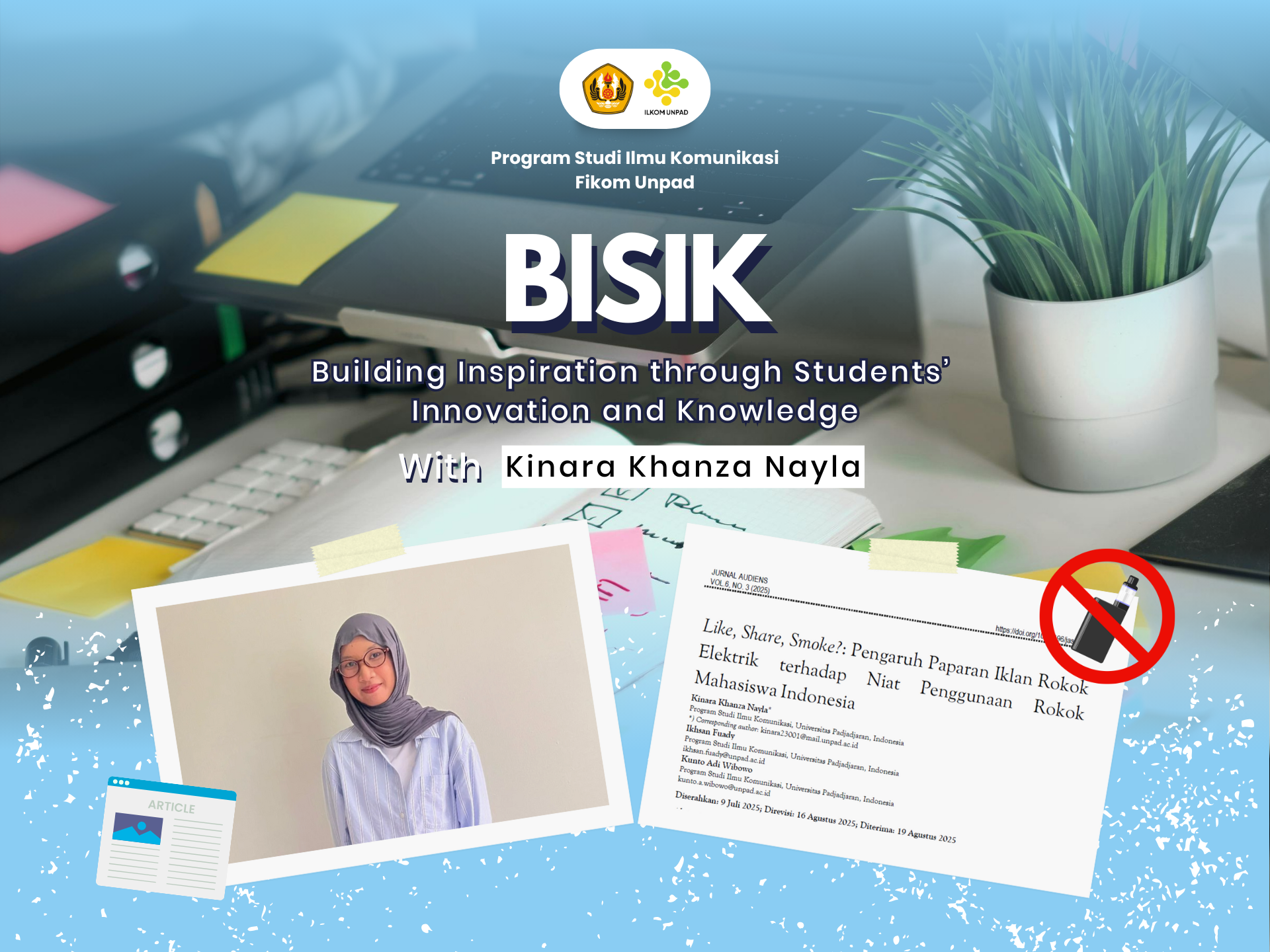
Hi, Ilkomers! Have you noticed how electronic cigarette advertisements have been appearing more frequently across social media platforms like Instagram, TikTok, and YouTube lately? These ads are often packaged as part of a modern lifestyle, even though the products themselves pose serious health risks. Interestingly, many students continue to use electronic cigarettes despite these dangers. This phenomenon caught the attention of a Communication Studies student from the 2023 cohort, Kinara Khanza Nayla, who explored the topic in a research article she wrote.
Kinara, who hails from Depok, is currently a fifth-semester student at Universitas Padjadjaran. Alongside her studies, she is completing an internship at the Career and Entrepreneurship Development Center (PPKK) Unpad, where she serves as the Manager of Graphic Design. In this role, she is responsible for creating visual guidelines and designing various templates for social media content on @karier_unpad.
Recently, Kinara published her academic article titled “Like, Share, Smoke: The Effect of Electronic Cigarette Advertisement Exposure on Indonesian Students’ Smoking Intentions.” The article that published in the SINTA 3-indexed journal was originally written as a final assignment for the Survey Methods course in her third semester. The idea stemmed from her observation of the growing presence of electronic cigarette promotions both in public spaces and on digital platforms. “At first, I noticed more and more e-cigarette booths popping up in malls, and later I started seeing their ads more frequently on Instagram and TikTok,” she shared.
From her observations, Kinara also noticed a clear distinction between the marketing strategies of conventional cigarettes and electronic cigarettes. She found that traditional cigarette advertising is rarely shown explicitly due to strict regulations, while electronic cigarette brands take advantage of loopholes in the digital space. They use subtle, lifestyle-oriented approaches, emphasizing trends, aesthetics, and modern visuals to appeal to younger audiences. This contrast further motivated Kinara to investigate how exposure to such advertisements influences behavior and smoking intentions among university students.
During the process of writing her article, Kinara admitted to facing several challenges. One of the main difficulties arose when compiling the literature review. At that stage, she found herself confused about how to structure the review systematically and in accordance with academic standards. After several consultation sessions with her lecturer, however, she managed to complete that section more effectively. Another major challenge came from the data collection process. To obtain valid and significant results, Kinara needed to gather responses from hundreds of participants, a task that required considerable time, effort, and strategy.
For fellow students who are currently working on their own research papers, especially the 2024 cohort, Kinara shared an encouraging message. She reminded them not to give up, even when the process feels overwhelming and exhausting. According to her, once the data is processed and the results begin to take shape, a deep sense of pride will follow, knowing that all the hard work has paid off. “Keep going, because in the end, you’ll realize that all your efforts were truly worth it,” she said with motivation.Kinara’s research also aligns with the Sustainable Development Goal (SDGs) 3: Good Health and Well-being, which emphasizes raising health awareness and reducing the negative impacts of risky products such as electronic cigarettes. Through her work, Kinara not only studies modern communication phenomena but also contributes to encouraging the public to be more critical of marketing strategies and more mindful of their health through ethical and responsible communication.
BISIK Vol #5