
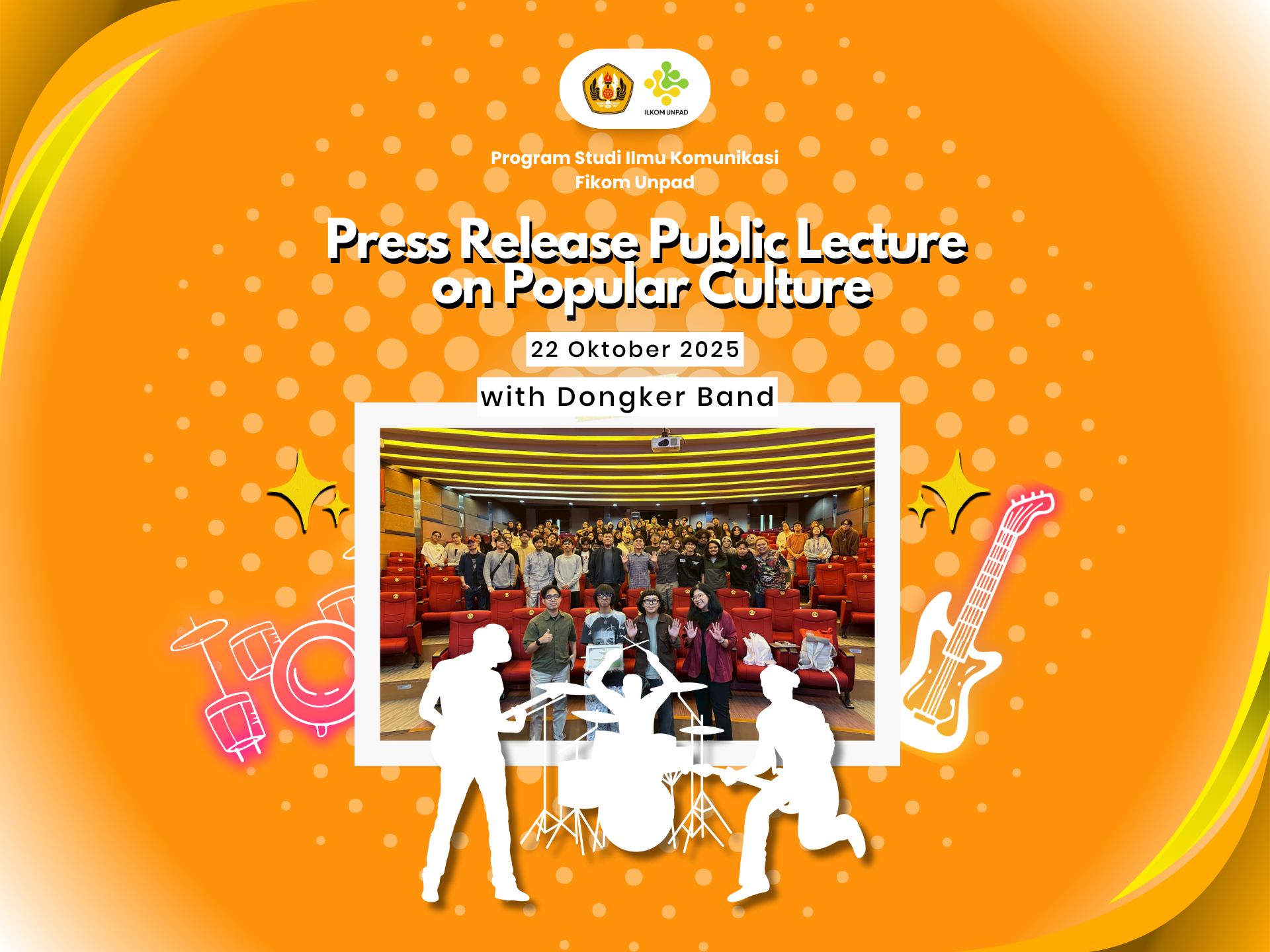
On October 22, 2025, the Communication Science Study Program at Universitas Padjadjaran held a public lecture titled “Dongker and Participatory Culture in Music.” The event featured Dongker, a punk band from Bandung, as the main speaker. This lecture served as an engaging discussion space connecting the academic field with the practice of popular culture, particularly in understanding how music can serve as a medium of social expression and a form of cultural participation in the digital era.
In the opening segment, Arno Zarror, vocalist and guitarist of Dongker, shared the story behind the formation of the band. He explained that Dongker was born from a creative student community at the Faculty of Art and Design, Bandung Institute of Technology (FSRD ITB). The name “Dongker” comes from the phrase “Bodong Kekar,” which represents their spirit as young musicians who are still “bodong,” meaning newly born in the music scene, yet determined to become “kekar,” meaning resilient in facing challenges. This philosophy reflects Dongker’s distinctive character as an independent and experimental band that dares to create works outside the mainstream.
Delpi Suhariyanto, the band’s guitarist, discussed the social background that helped shape the band’s identity, namely the Tamansari conflict in Bandung. The conflict involved residents of RW 11, Tamansari Urban Village, Bandung Wetan District, and the Bandung City Government regarding a low-cost apartment project during 2017 to 2019. The government planned to redevelop the densely populated area by constructing vertical housing, but the project site was located on land that had been home to residents for generations. In response to the situation, Dongker became involved in social activism, one of which was performing the song “Tuhan di Reruntuh Kota” (God in the City’s Ruins) at the eviction site as a form of solidarity and resistance. The band also extended its activism into the digital space by performing the song “Bertaruh pada Api” (Betting on Fire) on the popular online platform Roblox. This step demonstrated Dongker’s effort to introduce a new form of participatory culture by using digital media as an alternative space to voice social ideas.
The next segment focused on the meaning of music for the band members. For Dongker, music is not merely entertainment but a medium to communicate ideas and address social issues. Through their works, Dongker often explores three main themes: mental health, gender, and ecology. Arno stated that humans cannot be separated from art because art serves as both an expression and a form of resistance against inequality. He also emphasized that for Dongker, “resistance is an art,” and without the spirit of resistance, art would merely become decorative.
The use of the balaclava often worn by the band members was also discussed. A balaclava is a head covering that conceals most of the face and is often used as a symbolic identity in various cultural contexts. Arno explained that they initially wore it because the balaclava is widely recognized as a symbol of resistance in punk culture. Over time, however, it evolved into an artistic element featuring unique and creative designs. Arno and Delpi shared the stories behind each balaclava design used by Dongker.
The discussion then turned to the term Balada Dongkap, which refers to Dongker’s fan community. Arno mentioned that the relationship between the band and its fans has been very positive. The name Balada Dongkap was initiated by the fans themselves as a way to form their own community identity. The relationship has remained harmonious without any disruptive or harmful behavior from the fans.
The session concluded with a question-and-answer segment. One of the most interesting questions raised was about the band’s identity in relation to the merchandise they sell. Delpi explained that Dongker’s identity is not solely built through commercial activity. He gave an example of how some merchandise sales are used for donation purposes, giving them social value beyond mere commercial products. The event ended with a documentation session involving all participants.
This activity aligns with the Sustainable Development Goals (SDGs), particularly Goal 11 on Sustainable Cities and Communities and Goal 17 on Partnerships for the Goals. The discussion with Dongker reflected collaboration between the academic community and creative collectives in strengthening awareness of the role of popular culture as a medium for education and social expression.