
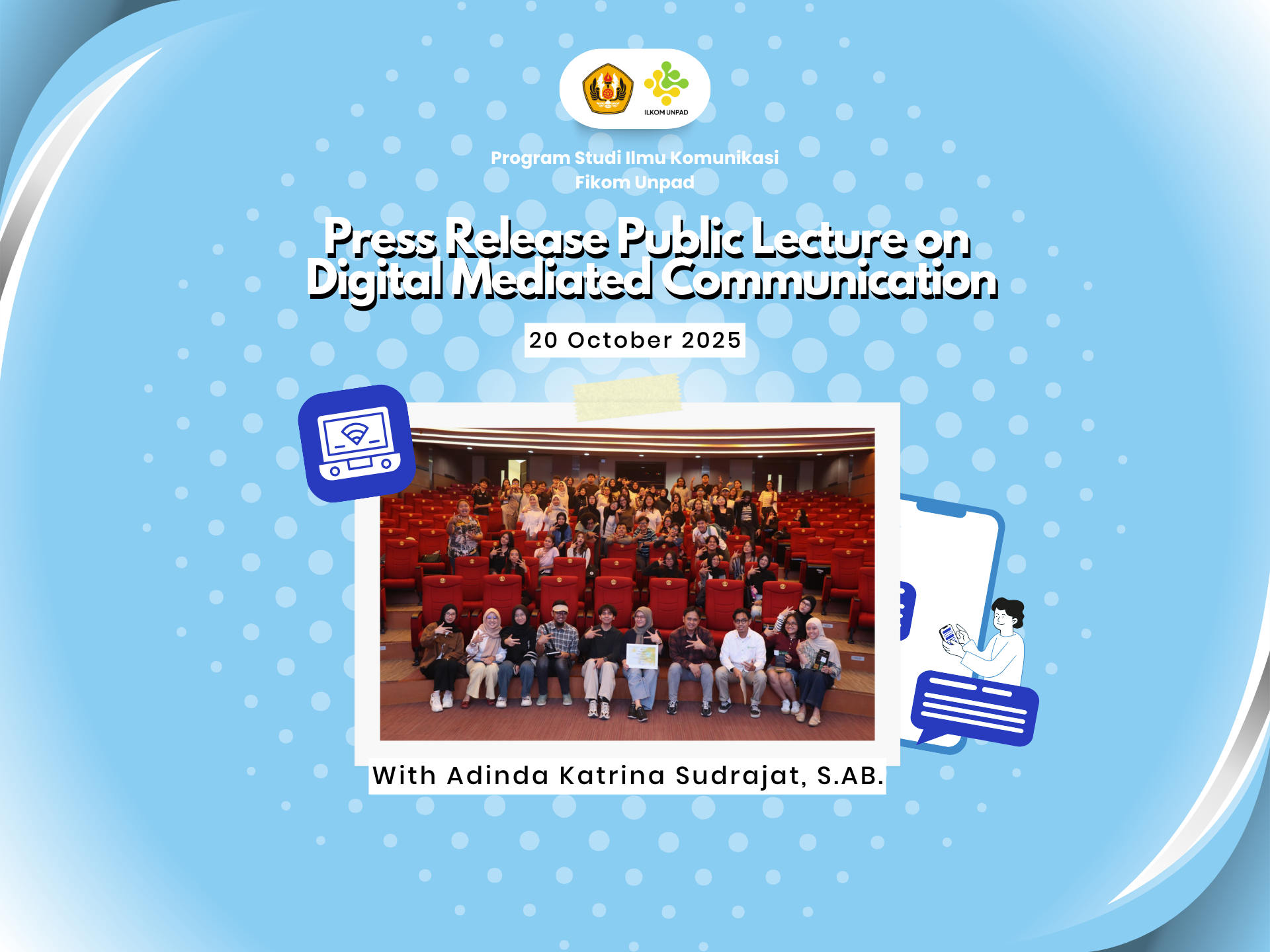
On October 20, 2025, the Communication Studies Program at Universitas Padjadjaran held a public lecture titled “Social Media: More Than Just a Communication Platform” featuring Adinda Katrina Sudrajat, S.AB., a Full Stack Digital Marketer at PT Noore Sport Indonesia, as the main speaker. This event provided students with an opportunity to gain a deeper understanding of the social media specialist profession, which has become one of the most relevant career fields in the era of digital media development.
In her presentation, Adinda emphasized that the role of a social media specialist requires well-planned communication strategies based on research-driven results. She outlined four main stages that a social media specialist should master: market analysis, audience persona creation, platform selection, and content execution and planning.
The first stage involves conducting market analysis to understand the needs, behaviors, and interests of the audience as a foundation for a more targeted digital marketing strategy. In this stage, marketers can build audience personas, which are detailed representations of the main target groups. Adinda explained five steps in building audience personas, namely collecting data, identifying patterns or groupings, segmenting the audience, creating primary and supporting profiles, and reviewing and updating personas periodically.
The second stage is creating content aligned with the previously developed persona. According to her, audience personas serve as a creative compass that guides messaging, visual style, and communication tone to match the audience’s values and needs. In digital marketing and communication practice, audience personas are generally divided into two main types: primary persona and secondary persona. The primary persona represents the main audience group that is the main focus of communication or marketing strategies. They are the most potential targets to purchase products, use services, or actively engage with content. In contrast, the secondary persona is an additional audience group that may not be the primary focus but is still important because they can influence or contribute to the communication objectives. For example, they may help distribute content to others.
In the third stage, Adinda highlighted the importance of choosing the right social media platforms by categorizing them into three main types: owned media, which are channels directly managed such as social media accounts and websites; earned media, which refers to organic publicity through reviews or user participation; and paid media, which includes paid channels such as digital advertisements and influencer collaborations.
The fourth stage is content execution and planning. In this segment, Adinda explained that each platform has different characteristics. For instance, Instagram is suitable for educational carousels and reels lasting 15 to 30 seconds, while TikTok is ideal for relatable first-person explainers and trend hijacking using viral sounds. In this stage, she also highlighted three key components: content pillar, content card, and content plan. The content pillar is the main theme or foundation of the content strategy, the content card is a more specific and contextual idea derived from the pillar, and the content plan is a structured guide for determining the schedule, frequency, and division of roles in content production.
Following the presentation, the event continued with an interactive workshop. Students were divided into several groups and asked to design a social media strategy for Divia TV, including providing three examples of engaging content tailored to the platform’s characteristics. After discussions, one student group presented their results to the other groups. The public lecture concluded with a documentation session involving the speaker, supervising lecturers, and all participating students.
Through this public lecture, students gained practical insights into the importance of synergy between creativity and data analysis in managing digital communication platforms. The event also aligns with Universitas Padjadjaran’s commitment to the Sustainable Development Goals, particularly goal 4: Quality Education, goal 8: Decent Work and Economic Growth, and goal 9: Industry, Innovation, and Infrastructure. These three goals underscore the role of higher education in producing digitally skilled graduates capable of contributing to sustainable communication development in the era of digital transformation.