
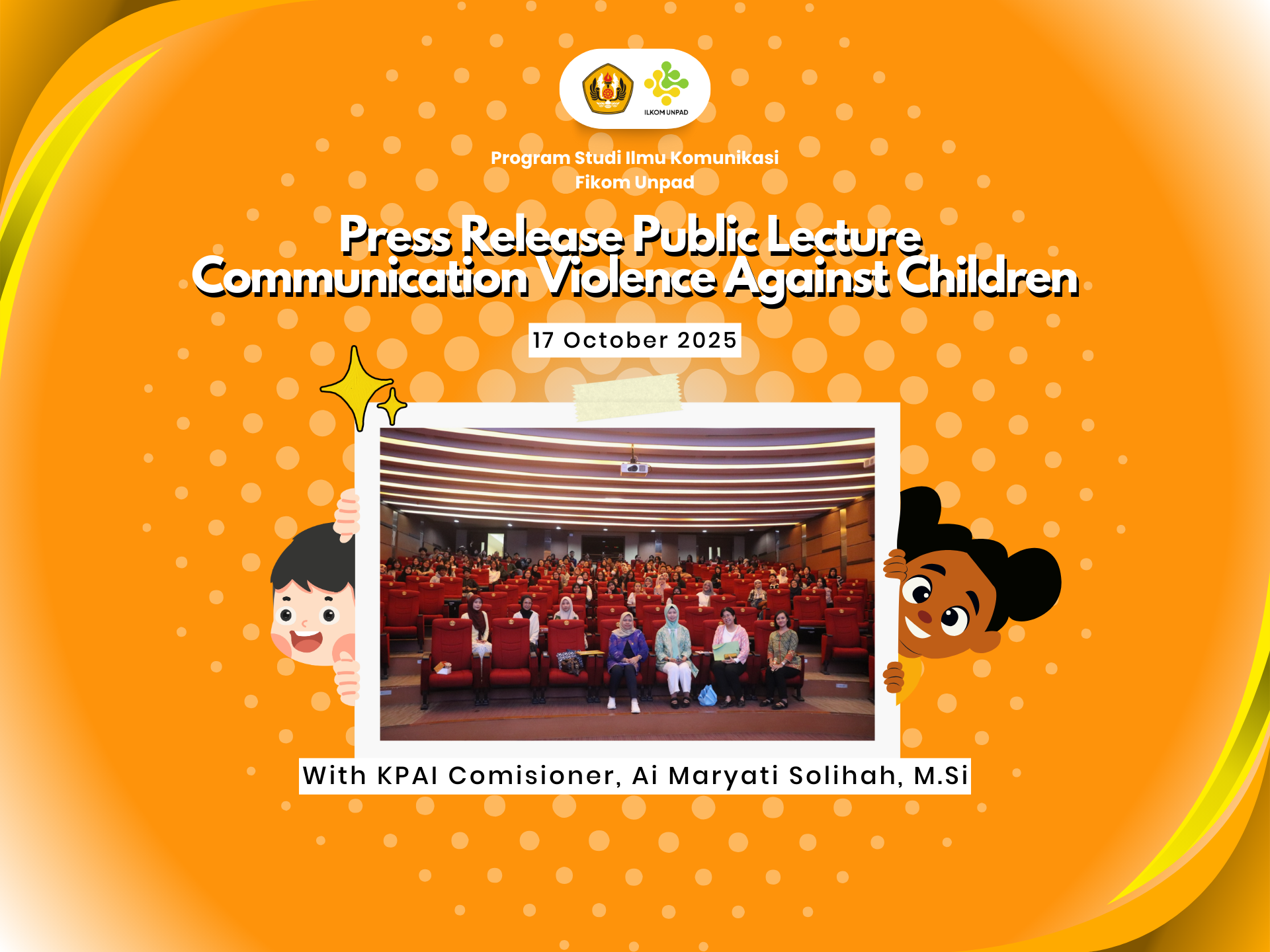
On October 17, 2025, the Communication Science Study Program at Universitas Padjadjaran held a public lecture titled “Communication Violence Against Children.” The event featured AI Maryati Solihah, M.Si., Commissioner of the Indonesian Child Protection Commission (KPAI), as the main speaker. This forum invited students to gain a deeper understanding of issues surrounding violence against children from a communication perspective, as well as the protection efforts that can be carried out by both the state and the wider community.
The lecture was divided into four main topics, namely the definition and rights of children, the current conditions of child protection and fulfillment, online-based violence against children, and preventive efforts carried out by both governmental and non-governmental institutions.
In the first session, AI Maryati explained that the category of children includes individuals under 18 years of age, including those still in the womb. This definition refers to Article 1 of Law Number 35 of 2014 on Child Protection. She also highlighted that Indonesia’s child population has reached 83,4 million, or about 32,24% of the total population. Therefore, she emphasized that child protection is a major responsibility shared by all levels of society.
In the second segment, Maryati discussed fifteen specific conditions that require special protection for children, including those who are victims of terrorism, sexual violence, drug abuse, disabilities, and pornography. She also underlined four key principles of child protection: non-discrimination, the best interests of the child, the right to life and development, and respect for the child’s opinions. According to her, these principles form the foundation for creating a safe and nurturing environment for children’s growth and development.
In the third discussion, AI Maryati elaborated on various forms of violence experienced by children, both offline and online. She highlighted the increasing cases of sextortion (sexual extortion) and sexting (sexual messaging) as concerning examples of digital violence. Based on KPAI’s data from January 1 to December 31, 2024, there were 2,057 reported cases of violence against children across different sectors. The impacts of such violence are not limited to physical harm, such as serious injuries or reproductive disorders, but also extend to psychological and social consequences, including difficulty controlling emotions and a higher risk of repeating violent behaviors in the future.
Addressing the root causes, Maryati emphasized the importance of parenting styles as a key factor in preventing violence. She noted that authoritarian or overly permissive parenting can contribute to the risk of child abuse, whether verbal or nonverbal. Therefore, she recommended a democratic parenting style that fosters open communication, emotional bonding, and provides children with space to learn about values and social boundaries in a healthy way.
In the final session, AI Maryati discussed preventive strategies that can be implemented by families, communities, and the government. She underscored that fathers play an equally important role as mothers in creating a safe and nurturing home environment. From the government’s side, she highlighted several initiatives such as digital literacy programs through the “Healthy Internet” campaign and collaborative efforts between KPAI, the Ministry of Communication and Information (Kominfo), and technology companies like Meta and Google in removing content related to child sexual exploitation and extortion.
The lecture continued with an engaging Q&A session marked by enthusiastic participation from students. Several questions raised included issues of abortion policy, the use of advanced technology to detect sexual exploitation content, and the psychological responsibilities toward child victims of violence. The discussion reflected students’ growing awareness and concern regarding child protection in the context of communication and digital media.
The event concluded with a group photo session involving all participants from the 2023 and 2024 cohorts, along with Communication Science lecturers. This public lecture represented a tangible commitment from the Communication Science Study Program of Universitas Padjadjaran to support the Sustainable Development Goals (SDGs), particularly Goal 16 on Peace, Justice, and Strong Institutions, as well as Goal 4 on Quality Education. Through this public lecture, it is hoped that Communication Science students can enhance their critical awareness of issues related to violence against children and understand the role of ethical and empathetic communication in creating a safer, more inclusive, and just environment for children in Indonesia.