
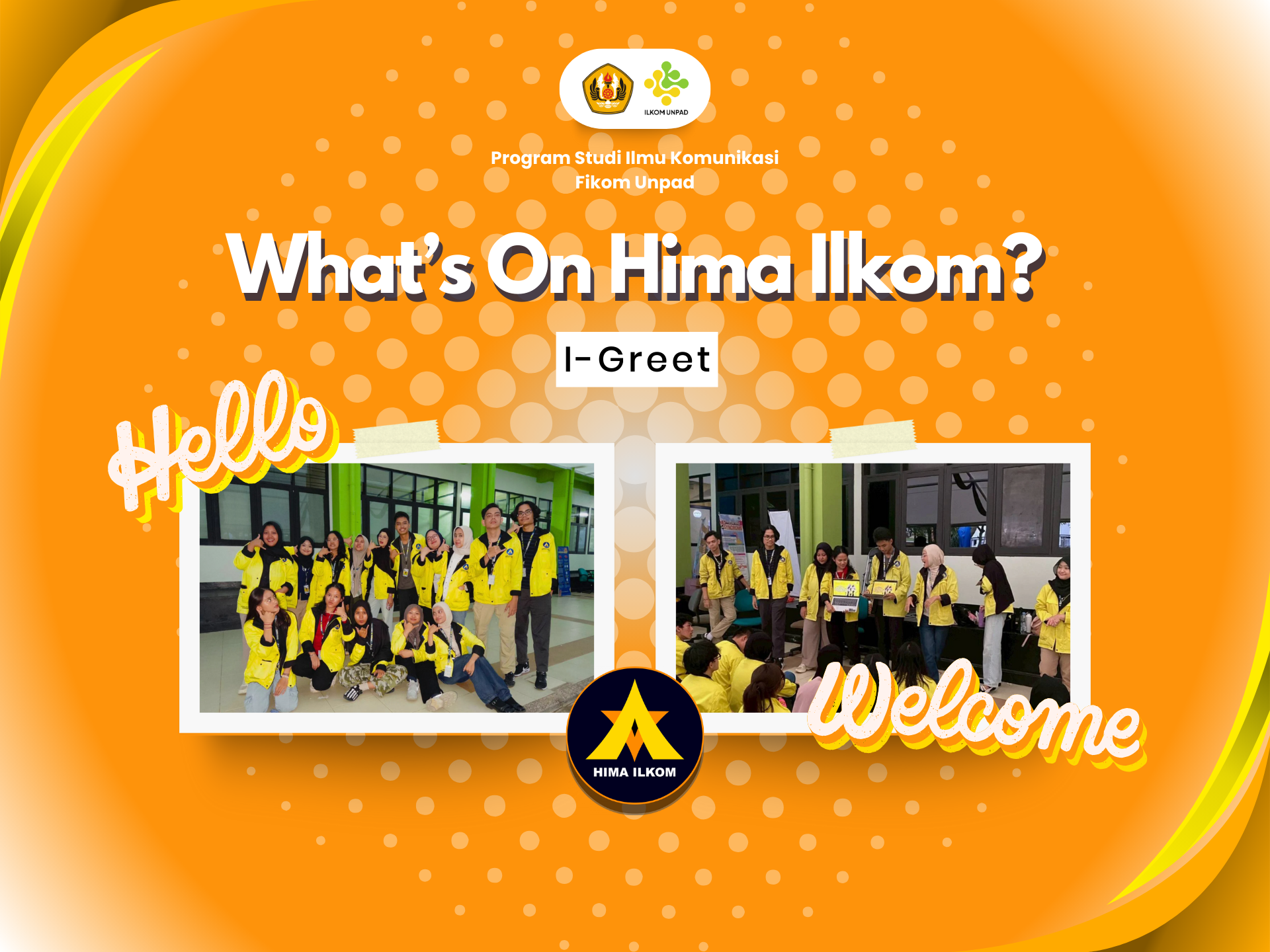
The Student Association of Communication Studies (Hima Ilkom) at Universitas Padjadjaran once again held I-Greet, a program organized under the Department of Student Resource Development (KPSDM). This initiative serves as an introduction for the 2025 batch of Communication Studies students to learn more about the structure and activities of Hima Ilkom.
According to Grace Juni Hotmaulina Saragih, the person in charge of the event, I-Greet functions as a continuation stage following the completion of the departmental orientation period. Through this activity, new students are encouraged to develop an interest in organizational involvement and to understand the internal dynamics of Hima Ilkom. The program introduces four main divisions, namely PDS (Personal and Social Development), Kominfo (Communication, Media, and Information), Student Affairs, and HRD (Human Resource Development). In addition, the event also provides an opportunity to introduce the Student Representative Council (DPM) as the legislative body within Hima Ilkom.
The event was designed using a post-to-post format, with each division allocated approximately 20 minutes to explain its roles and programs. This format was chosen to make the introduction more engaging and interactive. “Through I-Greet, new students can directly interact with each division rather than just listening to a presentation,” said Grace.
The agenda began with opening remarks from the President of Hima Ilkom, followed by a pre-test and an introduction to the special Pimkab (Cabinet Leadership) post, held at the Fikom Student Center. All participants were then divided into 16 groups, each consisting of around 11 to 12 members. Every group was guided by a mentor from the Hello Yellow program, another project under the KPSDM department. Afterward, each group was directed to specific posts according to the prearranged route. Once they completed the final post, participants filled out a post-test to assess their understanding of Hima Ilkom’s structure after receiving the explanations. The event concluded with a documentation session for each group together with their mentors.
Although the event ran smoothly, several challenges emerged during its implementation. One of them was unpredictable weather, as the activity took place near the end of the year. “We were worried about the rain since the participants had to move between posts quite frequently. Therefore, mentors were asked to remind their mentees to bring umbrellas or raincoats,” explained Grace. Another challenge involved coordinating the movement between posts to avoid crowding in one area. There was also an issue with schedule adjustments, as the committee could not use classrooms on Saturdays after 1 p.m. due to campus policy. Nevertheless, the organizing team managed to adapt effectively, ensuring that the event proceeded as planned. In terms of attendance, Grace mentioned that some groups were not fully present. “On average, each group had about seven members attending out of eleven, though there were a few that were complete,” she said. After the event, the committee held an internal evaluation session to review the program’s implementation and identify areas for improvement in future editions.
At the end of the interview, Grace expressed her hope that new students would gain a deeper understanding of Hima Ilkom and discover their potential through its various divisions. “I hope this event helps new students see opportunities to grow, whether by becoming mentors, joining a division, or contributing to Hima Ilkom’s programs,” she said.
Through the implementation of I-Greet, Hima Ilkom once again demonstrates its commitment to creating a collaborative and inspiring learning environment for new students. This program aligns with Sustainable Development Goal (SDGs) 4: Quality Education, as it provides an inclusive and adaptive non-formal learning platform. Upholding the spirit of participatory student development, I-Greet serves as an important first step for Communication Studies students to grow into competent, competitive, and socially responsible individuals within both academic and community settings.