
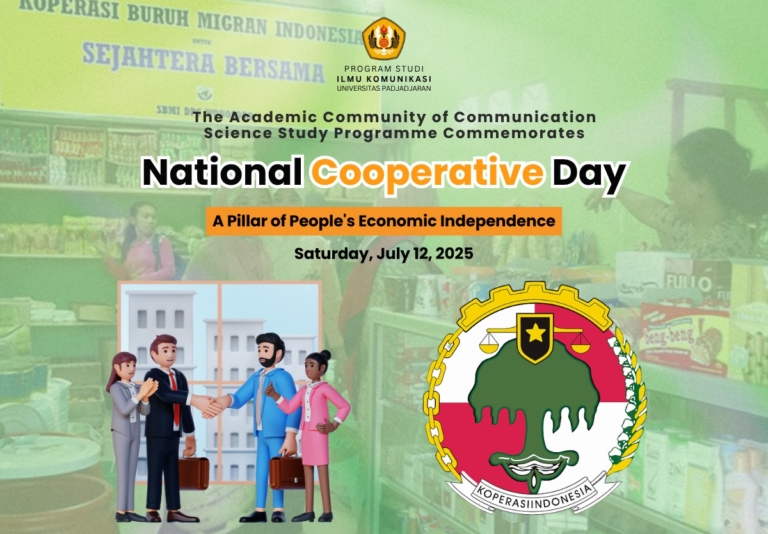
As a moment of appreciation for the central role of cooperatives to support the community’s economy, National Cooperative Day is celebrated on July 12 every year. Cooperatives are an economic model based on the principles of kinship and mutual cooperation that are relevant to the noble values of the Indonesian nation.
Cooperatives are a socio-economic movement that encourages member participation in decision-making and ensures that profits can be enjoyed together by prioritizing the principle of kinship. The principle of member participation in cooperatives is a concrete manifestation of participatory communication. Students can learn about how dialog occurs, decisions are made, and conflicts are managed in deliberation.
Mohammad Hatta, the Father of Indonesian Cooperatives, laid the foundation that cooperatives are the pillar of the national economy. He believed that through cooperatives, small people could unite and achieve prosperity together without being ensnared by an exploitative system.
Over time, cooperatives in Indonesia have grown. Not only focusing on savings and loans, cooperatives have expanded into various other productive sectors. This is an opportunity for the younger generation to make cooperatives a platform for collaboration, a place to develop business ideas, create jobs, and build a sustainable economy.
As Communication Science students, let’s make this moment a place to be able to go directly in applying the knowledge we have and contribute significantly so that cooperatives can be more inclusive, transparent, and relevant in the midst of changing times, as well as to support the economic independence of the people, and build a strong foundation for a better future. [Ed]