
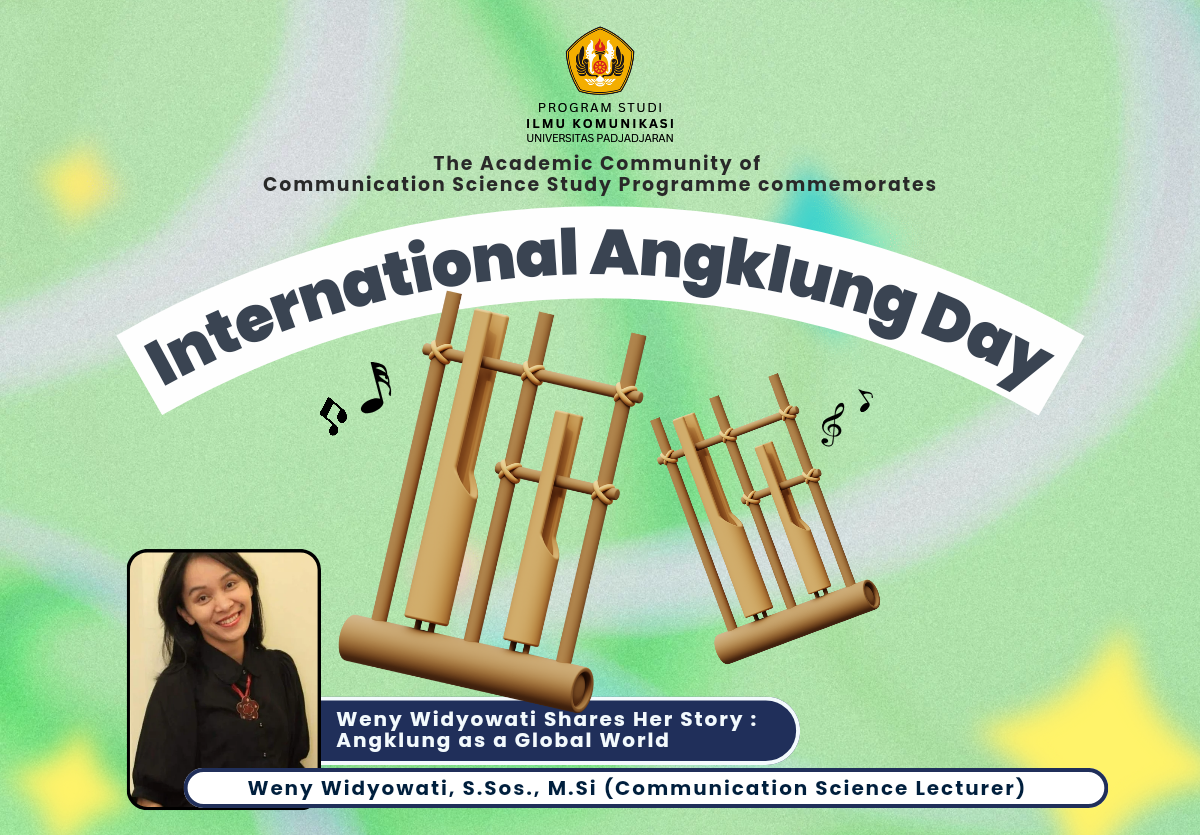
On November 16, International Angklung Day is celebrated annually by various art communities around the world. This day was established as International Angklung Day because it coincides with the recognition of angklung as an Intangible Cultural Heritage of Indonesia by Unesco in 2010. This recognition makes angklung not only seen as a musical instrument, but also as a symbol of unity and cultural diversity in Indonesia. Now, International Angklung Day has become an important moment for us to commemorate and appreciate the beauty of Indonesia’s cultural heritage that has been recognized globally.
Weny Widyowati, S.Sos., M.Si., a Communication Science study programme lecturer, shared her experiences playing angklung and her contributions in preserving the culture. She has developed an interest in angklung since primary school because her house was close to Daeng Soetigna’s, the founder of the modern diatonic angklung. Therefore, Weny always tries to play angklung whenever an opportunity arises, including when she’s a college student in Unpad with the Lises Club in 1992. In Lises, she played the big hanging angklung set which is why she’s often hard to see in performances because she’s positioned behind sets of angklung. Also, her palms were often bruised because the way to play a big angklung set is different compared to a single angklung.
Weny with the Unpad arts team at that time also did “culture diplomacies” to foreign countries like the Netherlands, Japan, and Australia. They don’t usually bring with them a full set of angklung and instead they only bring a few parts to introduce in small exhibitions, simple workshops, or as an accessory and additional decoration. But every time there’s an opportunity to travel abroad with a bigger team, with the exception of the Sunda dance team, they always try to create workshops where foreigners can be introduced to traditional musical instruments, one of which is angklung, and play them as well. There’s an interesting memory which is when she visited the Hiroshima Flower Festival, Japan in 1994. Weny and the team, which consisted of 5 dancers, didn’t bring any set of angklung at all, but they met with angklung players which consisted of a group of Indonesian diasporas and Japanese people who love Indonesia. So they shared their experiences and sang together. One of Japanese people’s favorite Indonesian songs is “Bengawan Solo” by Gesang. Besides Japan, in the Netherlands there’s also a diaspora group that loves angklung and they also teach it to the children.
She thinks that angklung is a culture that can easily ignite the interests of foreigners because of its uniqueness and simplicity yet the way it’s assembled and the presentation are also part of its attraction. Angklung can also be arranged for any songs whether they’re traditional or modern songs while still retaining that unique Indonesian culture sound. Introducing them is easier today with the existence of a more effective and efficient technique that allows smaller teams to play a full set of angklung. There’s also an interactive angklung playing method that involves the audience which is often done in angklung shows.
In the spirit of International Angklung Day, Weny hopes that the angklung culture will always live on everywhere, especially in Indonesia. Particularly in Bandung where Mr. Daeng founded it and where Mr. Udjo Ngalagena developed and promoted it. She also hopes that the sustainability of bamboo can be maintained and conserved by angklung craftsmen. She also wants to appreciate every person who contributed in preserving and developing the art of angklung until this day. “I hope angklung can be loved by the younger generation and be known by the entire world as a symbol of diversity and unity,” she said.Happy International Angklung Day! (Ed)