
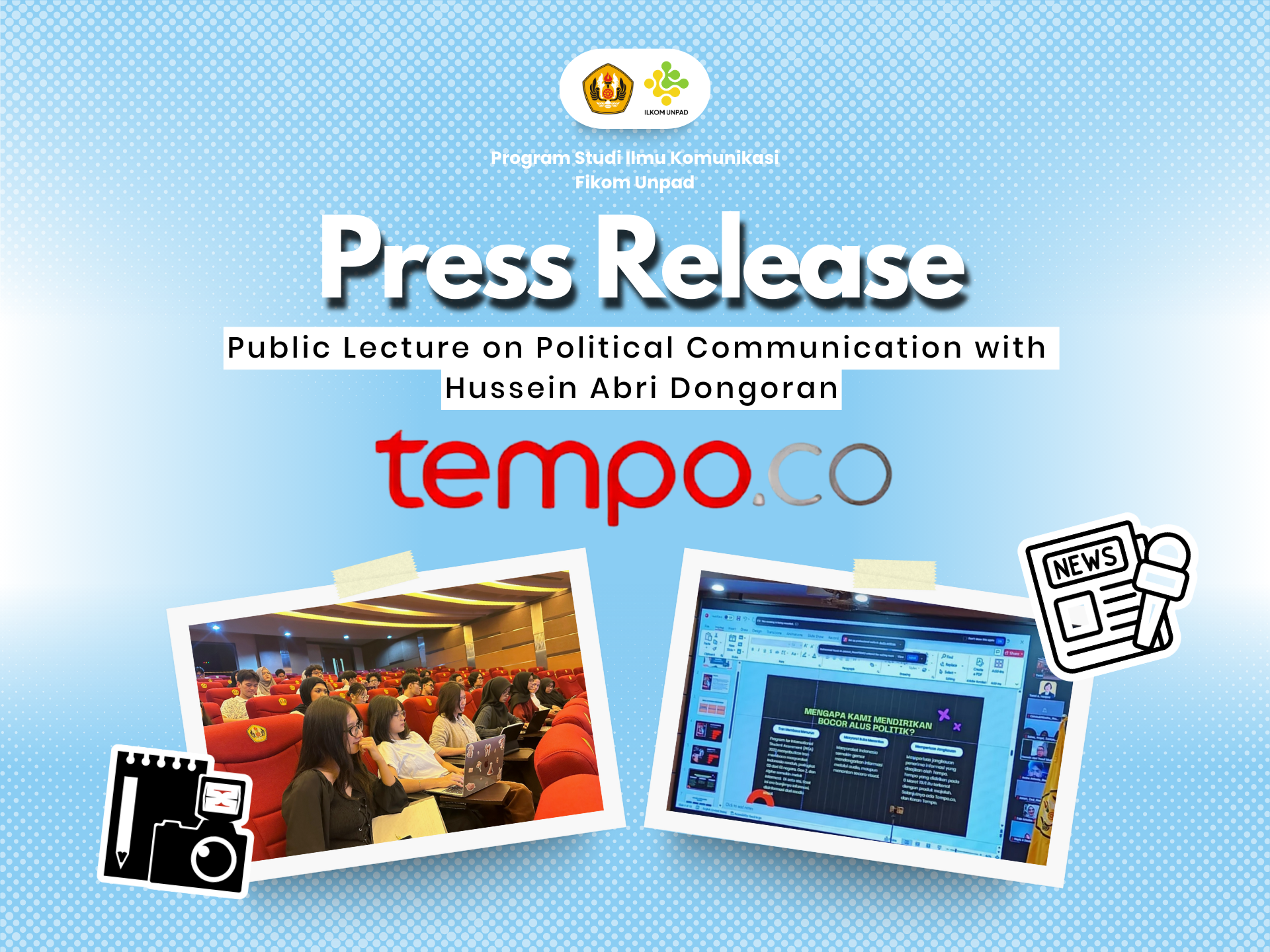
On September 21, 2025, the Communication Studies Studies Programme at Universitas Padjadjaran held a public lecture entitled “The Role of Media in Shaping Political Realities: Perspectives of Agenda Setting, Framing, and Priming.” The event featured Hussein Abri Dongoran, a Tempo journalist and host of the program Bocor Alus Politik, as the keynote speaker.
The lecture adopted a hybrid format, with students attending in person at the Auditorium while the speaker participated via Zoom. Hussein began his presentation by highlighting the history of Tempo, which was founded on March 6, 1971, and explained the strategies the media has implemented to adapt in the digital era through audience engagement, digital transformation, and cross-sector collaboration.
In his lecture, Hussein emphasized that Tempo’s journalism is rooted in public interest, rigorous information verification, and editorial independence. “Tempo consistently strives not to become the government’s public relations arm. We only present facts with layered verification, ensuring that public opinion emerges from valid data rather than manipulation,” he stated.
Hussein also discussed the challenges journalism faces in the digital age, ranging from declining readership, the proliferation of hoaxes from anonymous accounts, to regulations that often disadvantage the media. He further explained that Bocor Alus Politik was created in response to shifting patterns of information consumption, packaging political issues through video content while remaining grounded in Tempo’s investigative reports.
The students’ enthusiasm was evident during the Q&A session, with questions covering topics such as news framing, journalist safety in the field, and maintaining media credibility. Hussein stressed that Tempo enforces strict Standard Operating Procedures (SOPs) to protect both journalists and sources, including the right to anonymity protected by law, as well as evacuation mechanisms in cases of threats.
Concluding the lecture, Hussein encouraged students to be more critical in consuming information. “Read more, don’t swallow information from social media entirely, and support independent journalism by subscribing to credible media outlets,” he urged.
This public lecture aligns with the Sustainable Development Goals (SDGs), particularly Goal 16 on Peace, Justice, and Strong Institutions, which emphasizes the importance of access to information and press freedom as the foundation of democracy. In addition, it supports Goal 17 on Partnerships for the Goals through collaboration among academics, students, and media practitioners in fostering critical and sustainable political literacy.